

By Muhammad Amaan
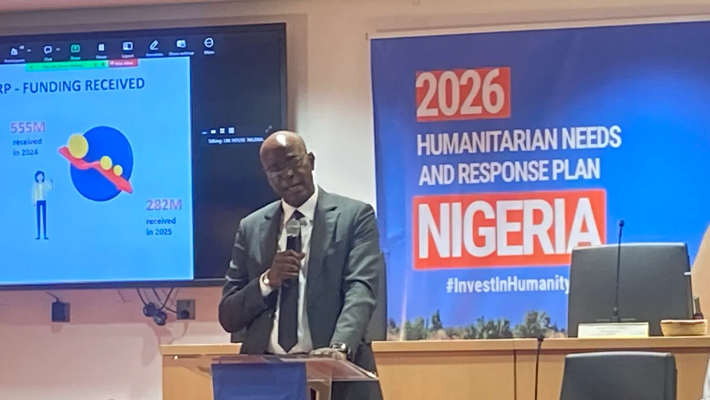
United Nations Resident and Humanitarian Coordinator, Mr Mohamed Fall, has reiterated the organisation’s commitment to supporting Nigeria to achieve its 2026 Humanitarian Needs and Response Plan (HNRP).
Fall disclosed this in his remarks during the unveiling of the 2026 Nigeria HNRP for Borno, Adamawa and Yobe (BAY) states, organised by the United Nations Nigeria, on Thursday in Abuja.
The introduction of the 2026 HNRP underscored the need for coordinated action to save and protect lives through humanitarian action led by the Nigerian government, supported by national organisations and international partners.
According to him, the UN internationally-led humanitarian assistance is ending in Nigeria, saying the next phase belongs to the country.
Fall said, “It belongs to the national institution. It belongs to the state authorities. It belongs to the civil society and it belongs to the community themselves.
“The transition of the humanitarian operation in Nigeria to be more nationally-led and resourced also is at the heart of the 2026 humanitarian ministerial responsibility.”
He expressed gratitude to Dr Bernard Doro, Minister for Humanitarian Affairs and Poverty Reduction, for the ministry’s strong partnership with the humanitarian community, adding, domestic resources are being mobilised to achieve targets.
“Government’s leadership and investment are critical for successful transition.
“As humanitarian partner, our focus will be on strengthening capacity of our national partner in coordination, planning, financing, and delivering humanitarian assistance.
“Nigeria is a country which is rich in resources, but which is also rich in capacity.
“Federal and State governments are showcasing leadership at national level, and community-based organisations are working at the centre of the humanitarian response.
“They bring trust, they guarantee access, and they guarantee continuity of service. Women-led organisations are shaping priorities, and communities also are working to find solutions.
“Our role is clear. We will continue to support life-saving action. We will defend the humanitarian principle. We will place protection at the centre of what we are doing. We will uphold the promises of leaving no one behind.
“We will invest in systems. We will strengthen partnership. We will continue to mobilize resources, but this has to be done alongside with the government of Nigeria, both at Federal, State and Local levels,” Fall said.
On his part, Doro, represented by Dr Yusuf Tanko, Minister of State for Humanitarian Affairs and Poverty Reduction, emphasised the need to adopt the model that had been practised to get a result in the North West.
According to him, over the years, humanitarian action has played a vital role in mitigating the impact of conflict, climate shocks, displacement and food security, particularly in Borno, Adamawa and Yobe.
The event focused on food insecurity and malnutrition, as well as goodwill message from Governor Professor Babagana Zulum, Governor Ahmadu Fintiri of Adamawa and Mala Buni of Yobe state.


