

By Muhammad Amaan
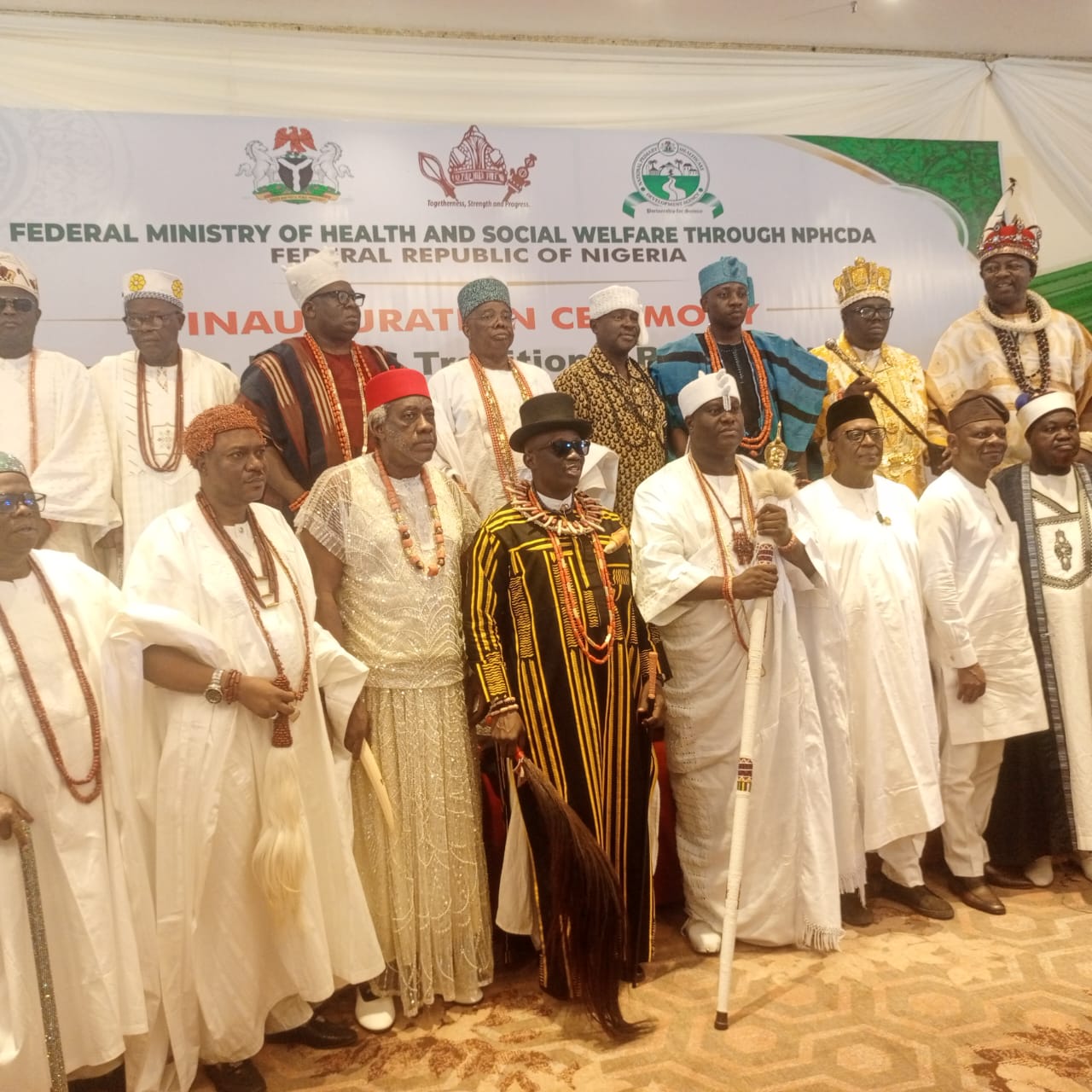
The Federal Government has inaugurated the Southern Nigeria Traditional Rulers Council Primary Health Care Committee to strengthen healthcare delivery and improve health outcomes across communities in the region.
The Coordinating Minister of Health and Social Welfare, Professor Muhammad Ali Pate, formally unveiled the committee on Tuesday in Abuja during a high-level engagement that brought together traditional rulers, government officials, development partners, and representatives of civil society organisations and stakeholders.
Prof. Pate urged the royal fathers to use their influence to drive immunisation, maternal health and community-level accountability across the South.
The Minister said the initiative builds on years of collaboration between government and traditional institutions, recalling that similar engagement with northern traditional rulers since 2009 had contributed significantly to the eradication of polio and improved immunisation coverage.
“In 2010, the last case of wild polio in southern Nigeria was recorded. But the burden was largely in the North. We realised then that government alone cannot solve public health challenges. We needed trust, and traditional leaders are the custodians of that trust,” he said.
He stressed that the new Southern committee would serve as a structured mechanism to support primary healthcare delivery, immunisation uptake, maternal and child health interventions, and grassroots accountability for health programmes.
According to him, traditional rulers remain critical in shaping community behaviour, noting that “in many communities, their voices carry more weight than policy documents or public campaigns.”
Prof. Pate also highlighted ongoing government interventions, including primary healthcare revitalisation, basic health care provision funds, and community-based programmes, adding that traditional rulers would play a monitoring and advocacy
role to ensure proper implementation.
He linked the initiative to resolutions from a recent national consultative forum convened by President Bola Ahmed Tinubu, where traditional and religious leaders agreed to strengthen structured engagement with government on national development priorities.
Executive Director of the National Primary Health Care Development Agency (NPHCDA), Dr Muyi Aina, described the inauguration as “a landmark step in rebuilding trust between communities and the health system.”
Dr Aina said the partnership with traditional rulers began in 2009 during efforts to combat polio, noting that their involvement had helped drastically reduce cases nationwide.
He emphasised that the new committee would be instrumental in addressing vaccine misinformation, improving immunisation uptake, and supporting efforts to end circulating variant poliovirus by 2027.
The Head of Mission at CWINS, Dr Mustafa Mahmud, in a presentation, described the committee as the formal operationalisation of long-standing concepts on community-led health governance.
He explained that the structure would serve as an apex coordination platform for traditional leaders across the 17 southern states, with responsibilities including advocacy, monitoring of primary healthcare facilities, and strengthening accountability at community level.
Dr Mahmud who stressed that the initiative was designed to bridge the “missing link” in health interventions, community accountability, argued that many well-designed national programmes fail due to weak grassroots enforcement and ownership.
The Chairman of the committee and Ooni of Ife, Oba Adeyeye Enitan Ogunwusi, praised the Minister for sustaining reforms in the health sector and commended the long-standing northern traditional leaders’ model, which has been operational for about 17 years.
“Our diversity is our strength. With over 400 ethnic groups in the South, we must harness our differences for national development. We are fully committed to this partnership for a healthier Nigeria,” the monarch said.
He also assured the federal government of the support of southern traditional rulers in strengthening immunisation campaigns, improving health awareness, and ensuring accountability in community health programmes.
The Deputy Chairman of the Northern Traditional Leaders Committee, HRH Abubakar Umar Suleiman (Mai Bade), shared lessons from the northern experience and reaffirmed readiness to support collaboration between both regions.
He noted that the northern engagement had significantly contributed to the reduction of polio cases and stressed the importance of continued cooperation between traditional institutions nationwide.
The Southern Traditional Leaders Committee on Primary Health Care is expected to lead advocacy on immunisation, maternal and child health, health-seeking behaviour, and community monitoring of primary healthcare delivery systems.


