

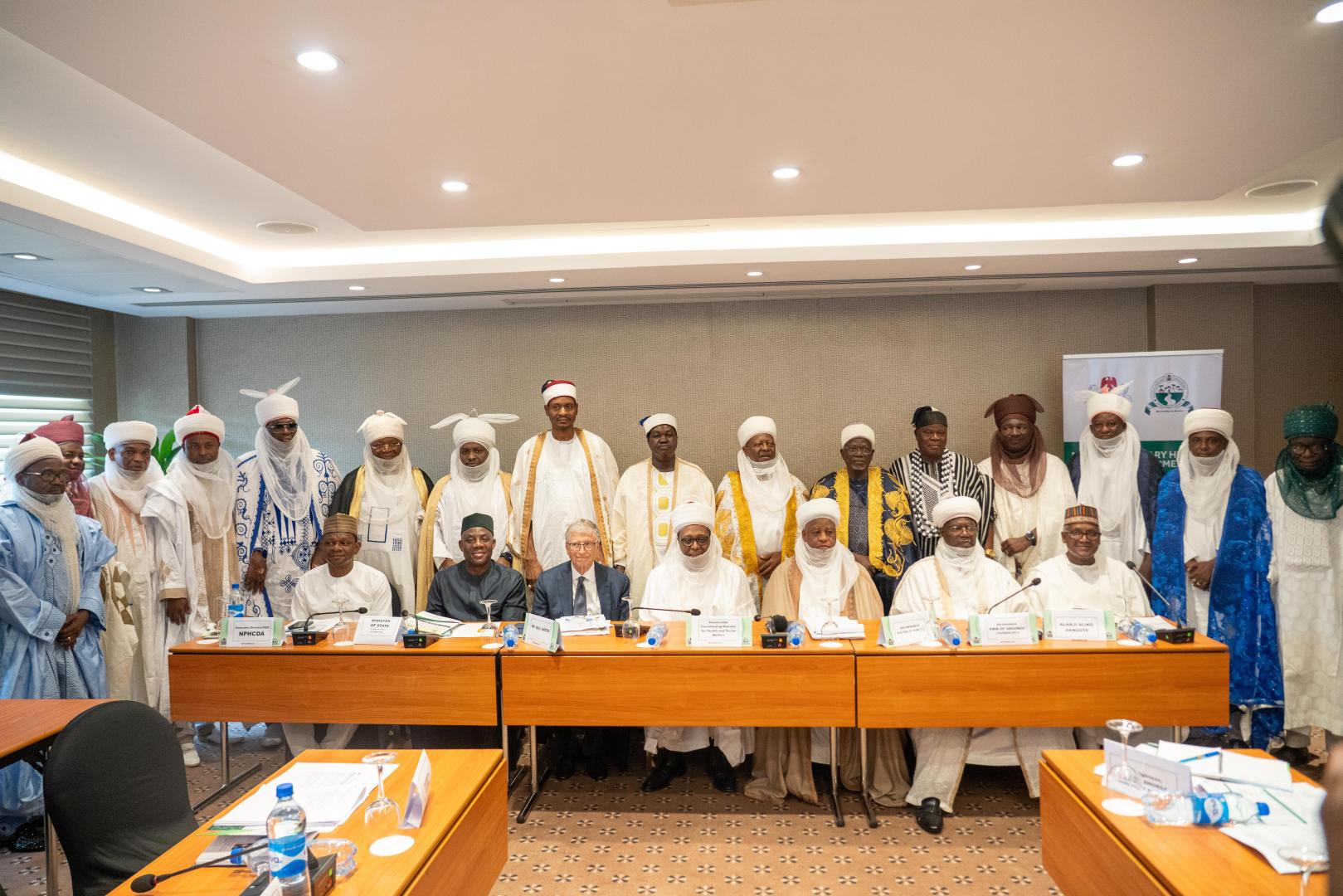
By Iyemah David
Traditional rulers from Northern Nigeria have called for greater accountability in primary healthcare delivery and intensified efforts to improve immunisation coverage amid concerns over circulating variant polio cases.
The call which was made at the quarterly review meeting of the Northern Traditional Leaders Committee (NTLC) on Primary Health Care (PHC) Delivery, held in Abuja on Tuesday, deepens the drive towards Universal Health Coverage (UHC) in Nigeria
Health Reporters Newspaper reports that the meeting organised by the Federal Ministry of Health and Social Welfare in collaboration with the National Primary Health Care Development Agency (NPHCDA), brought together traditional rulers and development partners to review progress and challenges in routine immunisation, maternal healthcare, and community engagement.
The meeting aligned with President Bola Tinubu’s recent mobilisation of traditional and religious leaders into Nigeria’s health sector reforms aimed at achieving UHC.
Under the initiative, traditional institutions have been formally integrated into the implementation framework for strengthening primary healthcare, improving immunisation uptake and advancing maternal and child health interventions.
The initiative is part of the Nigeria Health Sector Renewal Investment Initiative (NHSRII), which seeks to enhance coordination across all tiers of government and expand access to quality healthcare services nationwide.
Chairman of the NTLC and Emir of Argungu, Alhaji Samaila Mera, said primary healthcare remained the foundation of an effective and equitable health system, particularly for women, children and vulnerable populations in rural communities.
He said the meeting reviewed activities conducted between August 2025 and April 2026, including the most recent immunisation round held in April.
“We are going to listen to every state present at this meeting as to what they went through, what they did right, what they did wrong, and what the challenges are.
“We will take lessons from one another and ensure that best practices are replicated while mistakes are corrected at the community level,” he said.
The emir added that government was now paying closer attention to households where children missed vaccination exercises or had not received routine immunisation.
Speaking at the meeting, the World Health Organisation (WHO) Representative in Nigeria, Dr Pavel Ursu, said that although Nigeria was declared free of wild poliovirus in 2020, the country still faced challenges from circulating variant poliovirus, particularly in the North-West.
He said Nigeria recorded 87 cases in 2025 and 28 cases so far in 2026, with more than 70 per cent occurring in the North-West region.
He identified Sokoto, Kebbi and Zamfara as critical states in the effort to halt transmission.
According to him, what happens in the states will determine achieving a total eradication.
Dr Ursu commended traditional rulers for their role in building trust in vaccination campaigns and urged them to sustain community mobilisation and counter misinformation.
Nigeria Country Director of the Bill and Melinda Gates Foundation, Mr Uche Amaonwu, said traditional rulers had played a decisive role in Nigeria’s success against wild polio.
Represented by Mr Shina Aladeshewa, a Senior Programme Officer, Amaonwu noted that non-compliance remained a challenge in some communities and called for intensified mobilisation ahead of future immunisation campaigns.
In his keynote address, the Coordinating Minister of Health and Social Welfare, Prof. Muhammad Ali Pate, described the NTLC as one of the strongest community engagement platforms in Africa.
He said the Federal Government was implementing reforms to strengthen primary healthcare, expand access to essential medicines and vaccines, and improve health infrastructure nationwide.
Prof. Pate stressed the need for stronger accountability in the use of resources under the Basic Health Care Provision Fund (BHCPF), urging traditional rulers to monitor implementation at the community level.
He added that the government was prioritising maternal and child health, nutrition services and emergency care, noting that more than 500,000 women had been enrolled under the MAMI programme.
On his part, the Executive Director of NPHCDA, Dr Muyi Aina, said Nigeria recorded 30 circulating variant polio cases as of epidemiological week 19 of 2026.
Dr Aina said 27 of the cases were linked to variant poliovirus type 2, while three involved another strain.
He, however, noted improvements in the quality of recent immunisation campaigns, with Katsina and Kaduna states recording zero cases in 2026, while Borno also reported a significant reduction.
According to him, more than 28 million children received novel oral polio vaccines during the April campaign, while over 65,000 cases of non-compliance were tracked across 15 states.
He added that stricter accountability measures had been introduced, with underperforming vaccination teams sanctioned or removed.
Dr Aina also disclosed that over 4,100 primary healthcare centres had been revitalised nationwide, alongside increased direct funding to facilities under the Basic Healthcare Provision Fund.
According to him, more than half a million women had been enrolled in the MAMI maternal health programme across several states.


