

By Muhammad Amaan
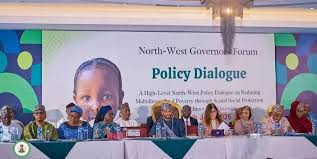
The governors of the seven North-West States under the auspices of the North-West Governors’ Forum (NWGF) has convened a high-level Policy Dialogue on Reducing Multidimensional Poverty through Scaled Social Protection Systems and Innovative Financing.
Health Reporters Newspaper reports that the dialogue bringing together policymakers, development partners, technical experts and key stakeholders from across the region.
The event which was held in Kano State, focused on identifying practical and sustainable strategies to address the drivers of multidimensional poverty, particularly among children, women and other vulnerable groups in the seven North-West states of Kano, Kaduna, Jigawa, Katsina, Kebbi, Sokoto and Zamfara.
Declaring the technical session open, Kano State Governor, Abba Kabir Yusuf, represented by the Deputy Governor, Murtala Sule Garo, stressed the need to view social protection as a strategic investment in human capital development, social stability and economic growth rather than merely a welfare intervention.
The governor said the Kano State Government had taken deliberate steps to institutionalise social protection through the enactment of the Social Protection Policy Law in 2025, which led to the establishment of a Social Protection Directorate under the Ministry of Humanitarian Affairs and Poverty Alleviation.
He noted that the state government continues to invest significantly in education, healthcare, skills acquisition, youth empowerment and social intervention programmes aimed at improving the living standards of citizens and reducing poverty across communities.
In her welcome address, Director-General of the North-West Governors’ Forum, Mrs Maryam Musa Yahaya, described the gathering as a defining moment for the region, given the growing socio-economic challenges confronting the North-West.
She observed that despite the region’s vast human and economic potential, it continues to grapple with high levels of multidimensional poverty, poor health outcomes, insecurity, climate-related vulnerabilities, displacement, fiscal pressures and a rising number of out-of-school children.
According to her, the challenges facing the region are interconnected and transcend state boundaries, making regional cooperation essential to achieving sustainable development outcomes and improving the welfare of citizens.
Mrs Maryam emphasized that social protection should not be regarded as charity but as an investment in stability, productivity and the future prosperity of the region.
She noted that small interventions such as scholarships, healthcare support, food assistance and livelihood programmes can significantly improve lives and restore dignity to vulnerable households.
She further disclosed that the forum had adopted the North-West Peace, Security and Development Framework as a regional roadmap for addressing the root causes of fragility while accelerating human development across the region.
The Director-General explained that the framework recognizes the strong relationship between peace, security, economic development and social wellbeing, and seeks to promote coordinated responses among states and institutions to tackle shared challenges.
She also called for innovative financing mechanisms to support poverty reduction efforts, urging governments, development partners, private sector organisations, philanthropic institutions and Islamic finance mechanisms such as Zakat and Waqf to contribute towards expanding social protection coverage.
Speaking at the event, the Managing Director of the North West Development Commission (NWDC), Professor Shehu Abdullahi, reaffirmed the commission’s commitment to collaborating with the North-West Governors’ Forum to implement development programmes capable of addressing the region’s developmental challenges in line with the Federal Government’s Renewed Hope Agenda.
In a goodwill message, UNICEF Deputy Representative in Nigeria, Dr. Rownak Khan, highlighted the severe challenges facing children in the region, including high maternal mortality rates, child malnutrition, stunting and limited access to essential services.
She identified child-focused social protection programmes, particularly unconditional cash transfers, as critical interventions for improving health, education and nutrition outcomes.
Also speaking, the Head of Human Development Section at the European Union Delegation to Nigeria, Dr. Leila Ben Amor, reaffirmed the European Union’s support for social protection and human development initiatives in Nigeria.
She commended the leadership of the North-West Governors’ Forum in fostering regional collaboration and stressed that poverty and insecurity can only be effectively addressed through coordinated regional and national actions.


